Monday, June 28, 2010

Prometheus

Nor wild romance, nor pride allured me here

Duty and Destiny with equal voice

sustained my steps: I had no other choice.

Something for Africa to do or say...

-Pringle


After a week of “bunking” (as my bishop laughingly called it), I'm ready to get back to work. This past week, and really the last two, have not been so effective for my project. Indeed, I have not moved forward much at all. The experiences I've had were enjoyable, certainly, but now I need to be more effective. I loved going to a World Cup match, and thoroughly enjoyed the Grahamstown Arts Festival, but those things really aren't why I am here.

For the past few months, I've struggled with enthusiasm. I remember with fondness the electric fire I felt for what I was doing as I prepared for a mission, and seek the same degree of energy in my life now. These past two semesters, though very busy, were really a time of cooling; the engine of my heart has slowed considerably. My passion has ebbed.

Part of that has been due to a lack of direction. Like a ship without a course is blown all about, it is difficult to make headway without clear goals. This journey has been plagued by that problem - where am I going in Africa? Why, really, am I here?

Problems are so much harder when they are undefined. Confusion is perhaps the worst of foes; when the conflict is clear, although the battle may still be incredibly difficult, it is possible to succeed. When the enemy is unknown, it is difficult to make headway, or, having made it, to know that one has advanced. Divine inspiration circumvents these problems, of course, but it seems that much of the time we are given to struggle a bit for ourselves in order to grow.

Mathematics provides a decent metaphor. Easier problems are spelled out in symbols; more difficult problems are described ambiguously in words.

And so I think on Prometheus, Fire-bringer. Prometheus' great service to mankind (in most of the myths about him) was that he brought fire. Light and heat. In my clumsy attempt at a metaphorical treatment here, light is clarity: Prometheus brings the ability to define problems, to see things as they are, and (abstractly) to see things as they can be. In this way, Prometheus brings hope. The earliest story of Prometheus actually links Prometheus and Pandora. Prometheus' gift inspires the gods to send Pandora's box, containing both ills and hope. Clarity and hope: Vision.

Fire is also a source of heat. Perhaps the most common metaphor is the link between fire and passion; given fuel, fire turns potential into energy. Our whole world is based on this idea: fossil-fuels consumed in controlled bursts of explosive fire provide the force, the motion, the drive, the energy of our lives. I'm not speaking about sex; that's one use of energy, but certainly not the only type of passion. And in most cases, it is fire that unlocks the potential. Interestingly, man doesn't have this ability in himself; he receives it from the gods. From Prometheus. Fire-bringer. Bringer of Vision and Passion.

And so what is the modern Prometheus? From where does modern fire come? This is not only an abstract question: “Where do I go to become passionate about what I do?” In the later Promethean myths, Prometheus is the go-between, the advocate of man with the gods, the one that brings gifts from the gods to man (for the moment, we can ignore the context of Prometheus' gifts). In Christian theology, this role is fulfilled by the Holy Ghost.

Indeed, the Mormon hymn gives us, “The Spirit of God like a fire is burning!” (Hymns no. 2). The Spirit of God is the Spirit of revelation; it provides clarity on otherwise unknowable things.

President Hinckley linked the Spirit of God to “a great, overpowering Spirit of optimism” (Ensign, Nov 1995, 72); I would say that the Spirit provides hope. Clarity and hope: Vision.

The Spirit also provides passion. Positive passion is often called enthusiasm: en-thou-siasmos – God in us. That is the function of the Spirit – to work inside of us and to set alight the fire of our potential, and to inspire us to do that which is good. Thus, Ether could not be restrained because of the Spirit of God which was in him; Nephi and Lehi could not be held by prisons, the disciples of Christ spake and they could not be held by bars or pits, because of the Spirit of God.

In other words, to gain fire, seek the Spirit of God.

Stepping away from Greek tradition and into Hebrew, continual fire is found in the temple, on the altar of sacrifice, in the candelabra, and on the altar of incense; significantly, at the scriptural dedication of several temples, “fire came down from heaven... and the glory of the Lord filled the house” (2 Chron 7:1): covenant making and covenant keeping. From one of my favorite lines of a hymn (though not in our hymnal – it may not be doctrinally correct) - “I have read a fiery Gospel writ on burnished rows of steel” (The Battle Hymn of the Republic): the scriptures. From the Book of Mormon and the Bible [paraphrase]: as they prayed, each was surrounded by a pillar of fire.

The methods are the same, and I don't mean to focus on them here. Simply that as we draw closer to God and seek the companionship of His Spirit, we are filled with Vision and Passion, and our potential turns into energy and reality.

I have found that to be true over the past few days. Over the past two weeks. Two weeks ago, when my enthusiasm was at its lowest ebb, I began to pray with a lot more intent than I otherwise would. That prayer led to choice clarity and vision about my future and about my immediate purpose here. Subsequent struggle to draw nearer to God – not merely to go through the motions, but to truly seek and wrestle with the Lord – have provided additional hope, vision, clarity, and passion. Sincere scripture study has augmented and extended the fire of the Spirit, and I am regaining the passion I once had for the things that the Lord would have me do.

I find comfort in that now, because I was not the original impetus for coming to Africa. I am here because I felt like I needed to be, feel like the Lord wants me to be, feel like I will need to have been here. Hence, the opening poem, which I found on a wall in Grahamstown – “Duty and destiny with equal voice sustained my steps. I had no other choice: something for Africa to do or say.” (Pringle, whoever that is)

And so this week I go back to work in earnest. And I feel the fire begin to return.


Here I am at the Stadium in Port Elizabeth, just before the England Slovenia match. It was a lot of fun, and as you can see here, I'm pretty excited about it. I'm holding an England scarf and flag in my hand, and a South African vuvuzela in my right. I didn't want to not wear a soccer jersey, so like the South African fans there, I'm wearing a Bafana Bafana jersey (the away jersey).

In the match, Ashley and I (Collins nephew, and the person I sat next to) asked an England fan who was painting his friend's face to paint ours as well, which he was happy to do. I'll post those when I get back.


The seats we had were incredible - eight rows up from the field itself, right at England's corner for the first half. We sat in the right row but wrong seats until someone came at halftime and asked us to move; at that point, it was even better though. My actual seat was halfway between the corner and midfield for the second half, which is exactly where Slovenia was defending, so most of the second half action was right in front of me. :-D

Btw, the English fans were a lot of fun. They had one whole section to themselves, where everyone was standing and cheering; stamping and shouting England, or singing (loudly!) "Rule, Brittania!" and "God Save the Queen."


Here are some guys on stilts advertising for a couple of shows in GRahamstown, during the National Arts Festival. Grahamstown Festival was a lot of fun; I saw some good shows, and a lot of beautiful artwork.


Louis Mhlanga (stick your tongue on the back of your top teeth, and then blow through your mouth so that your cheeks puff out a bit and the air sloughs off of them in order to get the right "h" sound here. It's a lot like the Welsh double-l if that helps anything), a Zimbabwean jazz guitarist and singer. He was VERY good, and very enjoyable to listen to. We spoke to him afterwards, and he was also very humble and down to earth. If you like jazz, you should find this guys cd- I definitely will when I get back.


Grahamstown was experiencing perfect autumn-like weather while we were there. Although it was a bit chilly at times, mostly it had the same beautiful refracted light and autumn like feel I would find at home, with the pleasant addition of flowers in full bloom, almost everywhere you looked.


I included this one because I am not usually very pleased with my pictures of people, and I feel that this one actually turned out quite well. This is Rebecka Rönndal. Note the fallen leaves behind her - again, Autumn.


And here are the three of us in Grahamstown. I think we were all pretty tired by this point, but we had a lot of fun regardless. Me, Macrae McDermott, and Rebecka Rönndal, form left to right.

Monday, June 21, 2010

Doors and Windows in the Wall


Doors and Windows in the Wall

I am uneasy with the saying, “Whenever God closes a door, he opens a window.” I understand the meaning, of course, but windows are not intended for travel; the saying leaves me feeling that God is restrictive.

I prefer the road metaphor - “This is the path to which I have been called to go.” One of my favorite books as a child, A Door in the Wall, blends the two metaphors: [When thou comest to a wall,] “thou hast only to follow the wall far enough and there will be a door in it.”

I borrow the phrase this week since I have the opportunity to walk a different road than I initially planned: BYU has rejected my request to go to Capetown and its accompanying World Cup match. Indeed, my coordinator (the person in charge of all the facilitators and all of the BYU Field Study students around the world) has strictly forbidden it, “walled it off.” Fortunately, I will still be able to attend a match in Port Elizabeth, but I was disappointed not to be able to travel the “Garden Route” from East London to Capetown. The landscapes and destinations along the route are supposed to be stunningly beautiful, and Capetown itself is said to be one of the prettiest places in South Africa. I had also looked forward to climbing Table Mountain and thereby bagging my first summit on the African continent. Both the mountain and the route will have to wait. I'll extend my future Kilimanjaro journey and tour South Africa first, take a trip through Malawi, and then conquer the shortest of the seven summits.

However, I find that this new set of opportunities may be as or more rewarding than a jaunt to Capetown. The evening I found out my request was denied, I was asked to escort someone to a “matric farewell.” This is the equivalent of a South African prom, but has the pomp and festival of a Latin American sweet sixteen celebration. It's entirely platonic – the girl is sixteen, I think – but it will be an interesting experience; a different side of Africa. Similarly, that same evening I was invited to accompany some local fisherman on one of their trips in the bay and out into the ocean. Although this may not initially sound fun to a non-fisherman, the sardine are currently making their run to Durban. Every time these fisherman go out, they see dolphins, whales, birds of prey, and interesting fish. On many occasions, the dolphins are close enough to touch; last week, a whale surfaced no more than 100 meters away. Also, I enjoy fishing, so enjoyment is guaranteed on that front as well.

I now have a chance to go to the annual Grahamstown Arts Festival; it's a yearly cultural event featuring dance, theatre, film screenings, live music, and a host of other activities. There's one performance in particular – San, a representation of the Khoi-San people - that I intend to attend. Again, it's another side of Africa; South Africa's own expression of itself through the performing arts. I was looking forward to South Africa's natural and historic wonders; along this path, I get to experience the living, human symphony as well.

I get another week to conduct research, including another two Sundays worth of meetings in my congregations. I don't have to miss sacrament meeting and can continue to work with my young men. I have been praying for help to do what I need to do here; that prayer has been answered through one way being hedged up, and another opened, blessed, and prospered. “Praise to the Lord, who doth prosper thy way and defend thee! Surely His goodness and mercy will ever attend thee. Ponder anew what the Almighty can do, who, with His love, doth befriend thee! … Hast thou not seen how all thou needest hath been granted in that He ordaineth?” (“Praise to the Lord, the Almighty,” Hymns no. 72)

I was stopped in a restaurant this past week by an inebriated man. We had a brief conversation, and then he said something profound: “You have something you need to do in this life. You don't know what it is – you must think about it a lot, and [pray] a lot [and figure it out].” Though intoxicated, what he said was true. I thought the Lord wanted me to go to Indonesia and Capetown; instead, He has provided other opportunities that will better enable me to do what I need to do. In this case literally, “it may not be on a mountain height … my Lord will have need of me” (“I'll Go Where You Want Me to Go,” Hymns no. 270)

I realize as I write that the “doors” the Lord closes are only windows onto daydreams; the “windows” he opens are pathways leading to our purpose, our eternal growth, and our ultimate exaltation. Indeed, it is often through the walls He puts in our way that we are led along the pathway we should go, until we come to the doors leading to the right experiences and the best blessings.


This is the lighthouse at West Bank. My hostess is starting a little catering business on the weekends, so I helped her nephew go and pick up tables this past Saturday from a restaurant down by the harbor.


And here was my first look at real Sprigboks! In their native, golf-course habitat! The Springboks are kind of a national symbol for South Africa. The national rugby team are called the Springboks, and South Africans are justifiably proud of them - they won the last Rugby World Cup, and are probably in the top three teams currently. (In fact, a Church member told me that the cricket team is also in the top ten, as are several other teams. Apparently, it's ONLY the soccer team that isn't in the top ten; Bafana Bafana is ranked 96th in the world.


Here is what I spent a good part of the week doing. I volunteered with a Baptist church's soccer camp, and helped to make sandwiches. I became the official logistics guy - it wasmy job to keep an accurate count and sort of the different types of sandwiches, which went to which leaders, etc. (once some of the sandwiches had been made and bagged. Until that point, I was part of the line). We got better thoughout the week - by Friday, we turned out 201 sandwiches in less that an hour and a half. It was actually pretty fun. Keenan, one of the young men, and I determined that if we made 200 sandwiches at 1R each, and sold each one for 5R (about 75cents, and the going rate for cheap food on Oxford St), that would be 800R profit each day, for about an hour and a half's work. Not shabby. The other people helping told us we were on our own, though - what, who doesn't want to make hundreds of sandwiches day, indefinitely?


Here are the YSAs at a fun Karaoke night on Saturday evening. It was a good group.


I opened the evening with the Backstreet Boys' "Show Me the Meaning of Being Lonely." In my defense, I only knew the chorus (I am a man, after all), but made sure to ham it up. Sadly, the person I asked to take pictures struggled a bit with my camera, so we only got blurry images, but one person got a video of it, so it is recorded somewhere.

They're probably planning on using it for blackmail, actually, now that I think about it.


The uppermost image, in the body of the post, is a picture of a really nice restroom (read: literally including a chandelier and mirror mosaic) in a girls elementary school. I was going for an abstract photo (remember, it's deep), but then thought it worked well with the title and so left it up at the top.


Tuesday, June 15, 2010

Turning Point

Occasionally, there come points in life, larger than normal, that change the course of our behavior. One such point came to me. Point is the wrong term – it's more of a turn, a curve rather than a discrete angle. One such turn came to me this past week, as I battled with a second bout of culture shock. This round was not so much a panic as a general unease, a nervousness in everything I did, the continual feeling of being a “fish out of water.”

These feelings were exacerbated by my attendance at a Pentecostal (I had originally thought they were Baptist, hence their inclusion in my research) Getaway weekend. Not only was I struggling with South African cultural expectations, but also with the difficulty of adapting to and operating in a different religious paradigm than my own. (Not that this involved many direct, external stimuli – most of this battle was in my head).

The trouble with the Pentecostal congregation really brought to a head the other difficulties I've been having. The people were wonderful – that wasn't the issue at all - I simply didn't know how to respond appropriately to them (in terms of humor, topics of conversation, etc – the thousand little things that cue and guide our actions everyday). Because of my unfamiliarity with this South African culture – my inability to speak the “language” of this country - I had been paralyzed with fear of offending someone. I was acting out of cowardice. Not that my behavior itself was all that different – simply, my motivation was fear and doubt, leading to over-caution and a lack of confidence in everything I did.

After feeling, and probably being, uncomfortable for about a day (the camp was a three day affair), I went paddling on a “paddle-ski” (like a kayak that one doesn't sit into, just on top of), I thought about it, and decided to be confident. Damn the torpedoes, full speed ahead, come what may. I'll try my best, and if I fail, or offend people, or whatever – so be it.

There was a lot of divine help with that decision; it was made in prayer. That change had been building for about a week - I found out this week that I will not be going to Indonesia this year, as I did not receive a Boren scholarship. I was selected as an alternate, which is an honor, but it was still disappointing. I was grappling with some of that disappointment when I made my decision.

The decision made, I have seen a stream of blessings flow from it. Everything is falling into place. The person who had taken my previous teaching job contacted me and said that they would seek employment elsewhere, so I may have a position when I return. Similarly, I was blessed, the day before I found out about Indonesia, to see the benefits of not going – graduating a year earlier, opportunities to date and get married, and opportunities to teach in East Asia over the summers.

Choosing to shed my fear and live in faith – for that is what I believe happened – has enabled me to enjoy my experience here to much greater degree. Do I have to like this food? NO! But will I taste it to be polite? Yes! Will I try to like it out of love for the people? Yes! Does that mean it is or that I should pretend it's pleasant the first time? No! Do I really like this particular thing (about South Africa, about America, w/e)? Yes – regardless of what a local, or a fellow American, thinks about it. Faith seems to give a person the opportunity to be themselves, genuine, to be different from others. Fear demands conformity, shuns the challenge of independence, and denies an individual the right to think or believe as they wish.

Faith also allows the Lord to speak to us; “by faith miracles are wrought,” especially the miracle of revelation, “for he had first seen these things with an eye of faith.” That seems to be a key to this life – that we walk in faith, without seeing (That's a Swedish translation. We walk by faith, and not by sight, is the proper English). Since choosing to be confident, I have had an easier time hearing the Lord's direction and following it.

I therefore testify of the scripture, “I would that ye were hot or cold.” Be decisive. Live in faith, not fear. “Whatever thou doest, do it wholeheartedly.” If you fail, fail giving it your best shot. Be committed to what you do. Win or lose, believe in what you're doing – and if you're doing wrong, change. Either way, don't doubt. Ponder, consider, decide, and follow through.

This has become a sermon, but I one directed at myself. I share because this is probably the best description of my week.

As a note of some of the other things going on – The World Cup has begun! The first day was exciting – the morning before the opener, I went into town and bought a Bafana Bafana jersey from a peddler on the street, and also bought a vuvuzela (one of the African horns that soccer fans are using. Vuvuzela means to kill with sound; apparently, it was originally an instrument used to stun or kill baboons. The noise it produces is supposed to mimic an elephants trumpet.) People were honking horns, and blowing vuvuzelas everywhere – the cacophony was amazing, and joyous. The person I was walking with remarked that the World Cup was really bringing South Africa together – whites, blacks, coloureds, and Indians were all cheering on Bafana Bafana together, and everyone was blowing the vuvuzela in support (even if they'd hated it a few months ago). It's a fun and exciting time.

And it's a fun and exciting time for me as well. I'm learning a lot, growing, changing. I'm having fun with photography, and taking a lot more pictures – I'll have to show you all when I get home. Things are going well, my project is coming along beautifully, and I feel that the Lord is with me. Who could ask for more?

Brett


Here is a sunrise in Cintsa, where I attended that Pentecostal camp. The location was beautiful, so I made sure to get up early Saturday morning and catch the sunrise. I wasn't disappointed - it was a fantastic experience.


Here's an interesting war memorial, to Boer-Afrikaners who fought in the First World War. This monument is at Buffalo City Public FET College (basically a Junior college) - now called Walter Sisulu University. Sisulu was a black freedom fighter in the apartheid years.


Cintsa again - the camp was beautiful. I was taking pictures all day - I think I ended up with about 400 - but couldn't get the midday ones to work until I tried close ups of some interesting plants. Here's one of my favorites from that little shoot.


This is my friend, Chris, on a paddle ski. Chris was the one who invited me along. This is Saturday evening.


Here is a little girl, Raywen, with a butterfly she found.


Here are two of the teenagers I was working with over the weekend - Cloey and Lynnae, if I remember correctly.


Sunrise again, a little earlier than the previous picture.


Saturday, sunset on Cintsa beach at the Cefani Resort.


Tuesday, June 8, 2010

Rhythm and Theory...

Last week was spent in very little pursuit of my project – appropriately, this has resulted in this week becoming very intensely project oriented. I had two observations and two interviews last week; this week, I've already had one observation and an interview, have two or three more planned, and then will attend a three-day Baptist camp this weekend. I hope and believe it will yield a lot of valuable information. (For the record, I didn't waste time - I simply worked on other projects; i.e., coursework that I needed to do, and worked through some class notes, as well as some creative work I describe below).

I also feel I've broken through some kind of barrier – a fear, maybe. I'm going to attend a World Cup match in Capetown, I'm going to buy souvenirs, I'm going to a Baptist camp in Chintsa (pop the tongue off the back of your teeth, as if tut-tut-tutting someone, and then “hintsa” simultaneously as you finish the pop); I attend young men's activities (as a leader), I'm helping with a soccer camp, etc. I feel like I'm in things now, and that's a good change.

Sundays – LDS services on Sunday, are and have been a blessing. I truly enjoyed fast and testimony meeting – spiritual food, quite directly.

I attended a Xhosa cleansing ceremony where two Xhosa choirs sang – one from a local church congregation, and one from the prison. The prisoners were phenomenal – in the tent where we were, the twenty-five of them sounded like a hundred, and their music was amazing. If I am able, I will post the video. The cleansing ceremony was a mixture of Christianity and traditional Xhosa beliefs, with both sides represented roughly equally. Three or four Christian ministers were there, as were the Xhosa royal family and a traditional Xhosa healer (who looked very dark in his countenance, - (his look, not his skin.)

Interestingly, people have trouble guessing my age here. I've had a few who guess correctly at 22, but I've also gotten three 28s, two 26s, one or two 24s, and surprisingly, two “18 or 19s.” I've started asking people I know how old they think I am, out of curiosity and just for fun, and seeing their reactions.

I wrote the beginning of a “grand” (attempting to explain a lot) theory this week. I'm still working on it. It's interesting – I feel simultaneously more rooted, and more shaken, than before I wrote it. I felt like there was some inspiration given concerning it, and I was very excited about writing it – Again, I think I've broken through into a different world, a different realm of my life. I'm not sure yet what this means, but it seems like I'm moving forward.

And now, off to get a rabies vaccination!

(Note, afterward - I wish I'd gotten ALL of my rabies vaccinations here. Painless, and 130 dollars less here. US- 200 dollars; SA - 480 Rand/70 dollars. Oi. But, they don't carry Japanese encephalitis vaccine at all, so that's a problem.)


The YSAs had a dance event. Rolanda taught us the first part o the diski dance (the national soccer dance) and Heather and I taught them how to Swing, and Brandon taught a little breakdancing.
This is Sipwesihle, one of the YSAs.


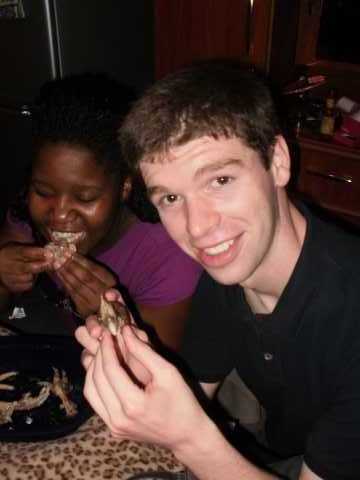
Here we are at Nokuthula's house, eating walkie-talkies, so named because they are in fact chicken heads and feet. The flavor isn't bad, but looking at them too long makes the feet begin to resemble human hands. Also, they're not particularly tasty - it's mostly fat and sinew - so I would recommend a stiff sauce if you're going to eat them, and a proclivity for crushing bones and beaks in your teeth. I didn't enjoy this meal too much, to be honest.


Here's Macrae making a frightening face behind Auntie P, while we were making cook sisters. Cook sisters are quite good - imagine an cinnamon wheat bread, made into doughnuts, deep fried in oil, and then boiled in syrup until soaked through, and then rolled in dried coconut. They're quite unhealthy, but pretty tasty.


Here's my abstract image for this week. Almost all houses here are ringed with razor wire (or the wall is topped by a very high voltage electric fence) - at least in suburban and urban areas. Slums, of course, lack such an amenity. I saw the wire here entwined with a flower bearing vine, and thought I'd snap a shot - something about beautiful nature and dangerous people. (Or about life, and the benefits of exercise. I don't know - I'm making this up as I go.)


Ok, this was just me being silly. I guess THIS is the abstract photo of the week - again, life and the benefits of exercise. It's deep, trust me.


The Xhosa cleansing ceremony was to bless an area in which four murdered women had been found stashed in a cave. A women's shelter we've worked with (they're the ones who invited us to the Trafficking in Persons Conference) invited us along. Afterward, we went to a prison for supper (the prisoners make and sell food at this particular prison.) This was a decorative carving in the hall, also made by a prisoner. I found something similar for sale for about 100 bucks yesterday; I just don't know how I'd get it home or what I'd do with it.


Here is Nokuthula demonstrating how to properly eat a chicken head, and me stalling before eating one. There just isn't a lot of meat on any of it; again, it's mostly fat, skin, tendons, and ligaments. Chicken tongue, for example, is meat - but the piece is smaller than my pinky fingernail.
Anyway, it was for the experience anyway, not to be filled. And, although I balked, and didn't eat much; I did try both, and did eat something, clearing both my name and my mother's for when she didn't want to eat Walkie-talkies in Columbian soups.


Tuesday, June 1, 2010

Changes - 5-29-2010

The seasons are changing here. I'm sitting in my granny flat, bundled up in thick woolen socks, wearing a shirt and sweater, and still shivering occasionally. I'm in the midst of the rapid South African autumn – three days ago, it was too hot to wear jeans.

I'm changing as well. I realized, looking back, that I needed a full two months to feel comfortable in my new ward in Stadium Terrace. I've been here two full weeks now, and I'm starting to feel comfortable. My research is progressing well – still in the preliminary stages, but moving forward - and I'm not as frantic about my field notes, though I'm farther behind than ever.

I hope this represents improvement – an increased ability to react and adapt – i.e., a shorter time requirement. If so, this is clear evidence of divine intervention and help, as I've blundered through the past two weeks.
Another change I notice is that I care for children a lot more than I did before. I hope that I have always loved children, but in the past two weeks, some of my discomfort around young children has decreased.
Tutoring has been particularly rewarding. As I sat and read with a young man named Nqaba (N – (pop the tongue off of the middle of the roof of the mouth, simultaneously moving the jaw downward) -ah -bah) I got the distinct impression that no one had ever read with him before – really read with him. He said he didn't like reading, but that he did like sports; his reading material was a junior encyclopedia volume on Sc-Sz, so we picked skiing and read about it.
Although I'm not a skier, I tried to enliven the reading with descriptions of my own – here's how the ski curves, etc. A lot of the entry was about Sweden, so I was able to incorporate some of my experiences there. Anyway, I didn't think too much of the reading session. The next week, I met Nqaba again, but didn't get to tutor him. He actually came early, as had I, so we sat and talked for a bit. After the students had finished their tutoring time, he and a girl and I walked to the taxi area together. As we walked, he mentioned that he reads at home now, and then asked, “You know why I like reading? It's because of you.” This was one of my proudest and most rewarding moments of the past year.
I don't know what the change was. Similarly, on our second trip to Zamani daycare, I felt far more comfortable with the children. Although I was uncomfortable and a little distant again at first, by the end of our time there, I was dancing and playing with the kids, and felt comfortable letting them climb on me. This was not good for my laundry – my shirt had a small dirt footprint near my collar, and the collar itself was a different color than it should have been – but it was good for my soul.

I think the Lord has other purposes for my being here. Based on an interview yesterday, I think that my research itself may be useful in helping the pastors in the area encourage their parishioners to act according to their faith. However, I think that the personal changes the Lord is causing in me will be far more valuable. I came here hoping, praying to be changed by the experience. It looks like that hope and prayer is being answered.
Interestingly, part of that has been a result of attending Baptist services. Honestly, I have been uplifted by the faith and love of the people with whom I work, and I do feel a unity and love with people of other Christian faiths and other religions generally. I think that a lot of my fears about other Christians have been allayed; I don't feel that I have been persecuted for my LDS beliefs. I thank my Protestant brothers and sisters for that – it has been a blessing to me.
This whole trip has been a blessing to me, troubles and all. I came here without a clear idea of why – I felt it was the right thing to do, but my original need to publish research findings in a scholarly journal evaporated with my success in sociological research. I will still do my research to the best of my ability, but I no longer feel that is why I'm here; my research seems to be a mechanism, not a goal. But the Lord is in charge, and I do feel that He is leading me onward. And so, I feel to cheer - “Lead thou me on!” (Hymns 97, Lead Kindly Light)
This is from Eastern Beach, the day I was walking to the Prevention of Human Trafficking Conference. I don't go to this beach often, but I really like it when I am able to.


This picture above, (Sorry, I'm having trouble tagging these photos) comes from a fun photo shoot I did around Valda's house on one particularly beautiful evening. Sunsets here are amazing. I often look into the sky to see a flock of birds winging in a turning arc across skies like the one above.
Photo below: I had some photographic difficulty in this stage of the photshoot, but I think the photo still puts the idea across. This is Valda's (and thus temporarily, my) backyard.


Here are the Kids at Zamani Daycare - we went back for their festival.
And here's Heather with one of the boys. They were clambering all over us that day - evidently, Macrae has a picture of me buried under about eight little kids. I'll see if I can get it from her and post it.

Just a random picture I took, that I thought was kind of fun. It's the bonus picture - I try to give 5 good ones, and the sixth may be questionable.

Wednesday, May 26, 2010

Pictures, and some musings.

Sorry for the grainy quality of these images - I had to resize and compress them to be able to upload them.


Here are the kids at the Zamani daycare. BYU students have been working with Zamani for a long time; they have helped build a couple of the buildings, and raised money last year to put another toilet in the bathroom.


Okay, I thought I had turned this picture, but evidently forgot to and now don't know how to do it on this page.
This wasa curious little girl who came in to peek at our meeting with Mama Yoyo, Zamani's director.


Zamani is in Duncan Village, one of the poorest and most dangerous townships in East London. Current townships are the remains of apartheid era squatter camps, when people were removed from their homes and forced to live in areas set aside for their particular race (Group Areas Act).


Note that almost each roof you see is a shack less than 20 foot square, usually more like ten feet square. The poverty here hadn't really hit me, until I saw a woman in town literally scoop a crust of bread out of the gutter and walk away, eating it. That same day, I came to Duncan Village - I want to express the difficult economic situation there to some degree.


A bit in the way of contrast, this was the braai (barbecue) at the Stake Father and Sons activity - the long sausages that were served are called boervoers (bo-er-vours(h))


Musings. This was a writing exercise in preparation to complete a class assignment on development and social change. I post this because I thought it might be interesting. I ought to warn: it's an experiment in sociology and Mormon doctrine, and probably includes a lot of my personal philosophy. I do not and cannot claim it as Mormon doctrine. Also - it's incomplete. I think the answer will, eventually, be simple. This is still quite muddled.
”You must widen your gaze.” What is the point of work? On what does the economic system depend? Society? Culture? In theory? On what should it depend? This is the great question of world order, the central question of the social sciences – what is the engine of the world?

"In the sweat of thy brow shalt thou eat thy bread, all the days of thy life.” Survival seems to be a basic thrust.

Wait – then it is dependent on the needs the Lord has placed in us. The need or desire to survive, the desire to love and be loved, the desire to become like our heavenly parents.

So, love, family, fulfilling the measure of our creation. These are the impulses that drive us. Truly, I think survival is simply a strong correlary to the other ones, but I do believe that it is subordinate.

Then fulfilling the measure of our creation, trying to gain the mind of Christ. That is what makes people move, act, be restless.

Love, then, and fulfilling our family covenants – making and keeping Gospel covenants – is indeed what impels us onward- inspires us onward.

Then, what are the prerequisites for Gospel service? For fulfilling the measure of our creation?

Mortality – a place to be tested, where we can learn and grow. The Lord has taken care of this one. Atonement – a way to be reconciled to God, after the Fall, a way to be forgiven; a way for us to gain experience, and yet be reconciled. From seminary and the Gospel, I assume then that the Creation is the remaining element – I had rolled this up into Mortality, but technically there was that physical element first, then the moral, then the spiritual.

The prerequisite conditions are then already in place. But what needs to happen in those conditions? The ground is cursed for your sake, and by the sweat of thy brow shalt thou eat thy bread all the days of thy life. Work- but more importantly, the exercise of agency in difficult circumstances leading to rewards in accordance with accountability (in the context of justiced and mercy). Work could probably be defined as the exercise of agency in difficult circumstances. Why? To grow, and become more like our Heavenly Father, to have joy – Men are that they might have joy, which requires agency, choice. That they might know to choose the good and reject the evil. The purpose of life then is to choose Christ; which so doing implies exercising faith, repenting, being baptized, receiving the gift of the Holy Ghost, being endowed, being sealed in the temple for time and all eternity, and receiving all and any other ordinances the Lord would have us receive.

The point of school, then, is to teach children to choose good; to choose God. Secular schools simply seek to do so covertly, in response to some of the evils taught in apostate churches or involved in the philosophies of men.

But I'm getting ahead of myself here. First, what are the prerequisites for choosing God? Life (in mortality, anyway, in this time granted for repentance), and building the kingdom – but what is building the kingdom? Building up the members and structures – no, really just the members. The ”structures” are simply patterns of member behavior; or codified patterns of member behavior. So, building up the members – no, proclaiming the gospel, redeeming the dead, and perfecting the saints. What does it mean to perfect the saints? It means to grow in Christlike attributes, I think.

Growing in Christlike attributes requires living, interacting with others, serving others, -exercising agency righteously, praying for them. It doesn't seem to require economic resources beyond simply being alive. However, living longer increases our ability to grow – it increases the number of choices we have. The quality of our lives appears to increase the degree to which we can help others to grow – it provides a security net which allows for a greater degree of mercy, I think. Mercy ultimately allows us to become what we could not otherwise become, through the Atonement, and in mortality it allows others to become what they could not otherwise become; to learn from otherwise debillitating mistakes. But this happens on an individual level – the wise stewardship of personal resources must be a key element. Gathering resources, (financial, economic, social, political, emotional, intellectual, spiritual) and then using resources for righteousness, ”while the sun shines, before the night of darkness wherein no man can work.”

Social use of resources would probably just be extensions of individual wise stewardship of resources – i.e. those who use their own resources wisely expect that of their government and society. Note that ”wisely” here does not mean ”greedily,” or miserly. Resources are meant to be used and enjoyed; the earth is here for the benefit of man. Not to be exploited – ”not by extortion or excess,” but to ”gladden the eye and enlighten the heart,” given for the benefit of man. Thinking of the earth and its riches like the rch experiences available to us in our bodies seems to be a good analogy (gratitude to Prof. Chip Oscarson for this idea) – if we treat our earth like we treat our bodies, that seems to be about right. Neither a museum piece to be kept in a glass case, nor an object to be abused, but as a temple – to be respected and enjoyed, and used. (Note: unlike a temple, or our bodies, the earth IS separate from humanity, and we are to be wise stewards or caretakers of it. Men and women are the children of God, whereas nature and the rest of creation is the workmanship of His hands – although I love nature, man is more valuable than animal. That said, the rest of creation is an essential part of our lives – subordinate, but necessary and wonderful.)

Proclaiming the Gospel requires the freedom to practice religion freely, to speak freely, the freedoms necessary to live the Gospel. Incidentally, it does not appear to require political freedom, the freedom to elect or choose leaders, although democracy seems to be conducive to the exercise and existence of religious freedoms.

Redeeming the dead requires temples; which demand a certain degree of economic wherewithal and political or social autonomy; however, again, this does not seem to need to be much beyond existence (with the Lord's blessing – see the poverty of the Saints in Kirtland and Nauvoo).

Returning to the recurring theme of all three events, the importance of being alive, the basic need is to live. Beyond that, not much else sems to be required, other than access to the Gospel – to the words of the Lord, to the doctrines of truth, and to the Lord's priesthood power here on the earth.

So, the first link in the chain is to help people stay alive. Adequate nutrition throughout life and the healthcare to extend and improve life as well become high priorities. To get nutrition and healthcare, work must be performed – crops must be planted, seeds must be harvested, meat must be butchered (vegetarians may disagree with the must, but the point remains), etc. Medicines must be produced, doctors must be trained, etc. Shelter is probably more important to health than almost anything else – warmth, sanitation, etc. Homes; houses, places of residence, etc. In economic and sociological terms, the system that supports the greatest number of individuals, then, for the longest period of time, is preferred. This priority allows for differences of opinion and differences in approach – i.e. Some believe corporate agriculture is more sustainable than local agriculture, etc. That question can best be determined by research, especially into ”basic indicators” - infant mortality rates, maternal mortality rates, life expectancies, etc.

This brings me to a rather startling revelation – living apparently ought to, generally be prioritized over dying with freedoms, except where living takes us farther away from God (the benefit of living being to come closer to God). This is difficult for me to reconcile. Men are that they might have joy – so which is better – a life of slavery or glorious death in a noble cause? I feel a kinship with Hamlet – whether tis nobler in the mind to bear with a sea of unending trials, or, by struggling, to end them?

Apparently, this question has a situational answer. In the Book of Mormon, one of the leaders mentions that they go to a defensive war; that if the Lord had commanded them, they would suffer themselves to be brought into bondage, but as the Lord had not commanded them and had instead commanded them to defend their wives and their children even if it required bloodshed, they went to war. I think it is also so in our own lives – sometimes He calls us to bear with our trials, and sometimes to end them, even at the risk - or cost, or sacrifice, or gift - of our own lives. The Lord will ask us to do that which will bring us and others closest to Him; but that knowledge is only truly available to God. This underlies the absolute need of revelation in our lives.

I guess the main point here is that systems that favor more people are usually preferable over systems that prefer less, assuming that they increase the ability overall of people to come unto Christ. I take great issue with rich, white Americans, or powerful minority Americans, who suggest that ”we” (the world) should stop producing so much food, to protect the environment, or whatever. Someone once admitted to me, ”Yeah, perhaps we wouldn't be able to feed as many people, but...” This strikes me as very elitist – the people who make such comments are rarely the ones who would be affected by the loss. They are not the ones who would die.

Anyway, this comes up in context of something I heard at a conference on Tuesday to prevent human traficking. ”Children's rights trump culture – culture is something that should enhance and enrich our lives, not detract from it.” I thought of how rights are culturally determined; although I agree with that position, it requires either ethnocentrism or a philosophical foundation of absolute truth/objective, non-culturally determined standards. I have attempted to demonstrate and illustrate such a philosophical foundation here, based on my understanding of the Gospel of Jesus Christ, as Restored to the earth by the hand of the Lord in these modern days.

With such an understanding, I reject the position that increasing standards of living (as measured in medical life expectancies, etc.) is inferior to ”cultural preservation.” Stated positively, life trumps culture. Again, drawing on something from the conference (actually, the next phrase in the previous quote) - ”and culture is always changing! It's always evolving.” I spoke with Rebecca, one of the people there with me, about it – and I came to the conclusion in the conversation that change is inevitable. The point of development or effort, or whatever, is to manage the change that happens; to make certain that the change is positive.

Critques of society, at least in Gospel terms, ought to recognize the prioritization of values in order to best help bring about the ”immortality and eternal life of man.” Perhaps this is my deep-seated objection to much of what I have read in the field of sociology. The vocabulary and mental exercises of the discipline are excellent, but I think that often, sociology is based on or used to justify a worldview rejecting God.

Similarly, critiques of development are only valid insofar as they address the imperfect (and occassionally malicious) execution of helping othe people. I reject the position that we should not strive to help others as best we know how; rather, critiques should help us better know how to help others reach or progress according to absolute goals. With a philosophical foundation allowing for objective criteria, or at least criteria that supersede culture, this is possible. I've heard of Catholic scoiology, based on Catholic doctrine. I guess that I am trying to develop a framework for Mormon sociology.

I make a bit of a mistake here - the priority is not in preserving life, but in preserving opportunities to choose righteousness, to become like our Heavenl Father.Back to the purposes and activity of life. Survival is, usually, a prerequisite of coming closer to Christ. Another activity that generally helps – well, there are a thousand things. Even surivival is not a given – sometime, we may be asked to give up our life.

It's whatever the Lord asks us to do. Hence, the need for continuing revelation, for we often do not know what is best in a given situation. Personally, and as a world – prayer and prophets, service and scriptures.

In these days, we have living prophets who lead and guide us, who help us to understand our duty. We pray to discover our individual path in that world. We follow the Lord's commands and the Savior's example, and we come closer to Christ. We fill the measure of our creation, and experience joy therein. This, truly, answers the questions of both personal and collective activity (when coupled with revelation). It is right to follow and serve the Lord, as He directs, both in our individual and social (or collective) behavior.


It's interesting – as I was wrestling with these ideas – What is the nature of the world? How am I to understand and consider the global and national systems that I study? - I listened to April General Conference in the background. As I typed and considered, the talks from the first general session described duty, responsibility, our relationship to God, and the purpose of life. I found some of the answers I was looking for in the talks playing in the background. I will conclude, as did Bishop McMullin (I believe) - ”Let us hear the conclusion of the whole matter: Fear God, and keep His commandments, for this is the whole duty of man” (Ecclesiastes I think).


And a bonus picture for those who read through the musing: Hudson, my host family's dog.


Monday, May 24, 2010

Culture Shock

I've spent the last few days struggling with culture shock. Interestingly, I dismissed culture shock when we discussed it in class – I felt that I hadn't really experienced it while I was in Sweden, and so didn't need to worry about it for this trip either. I assumed I was one of those lucky few who adapts to new cultures without difficulty.

For reference, culture shock is the mental discomfort experienced by travelers who find themselves robbed of the cultural cues that make the world make sense. These are usually small and subconscious: the way a man looks at a woman when he wants her attention, and when he does not; the appropriate topics of conversation with new acquaintances; the implications and connotations of association with other members of society of various socio-ethno-economic backgrounds; the meaning of friendship.

Let me give an example. Solitude and quiet are both fairly standard concepts in North American / Northern European culture; we even use the expression “peace and quiet,” positively to denote a state of equilibrium, homeostasis, or rest. This is not apparently a common South African theme.

More importantly, the expectations based on that theme are not effective or useful as behavioral guides in South Africa. It is not so simple as, “Everything is the opposite of America” - rather, the pattern relies on different – unknown – logic. Hence, anxiety.

The lack of quiet particularly unnerves me. My roommate listens to music, the domestic servant leaves the television on, precisely so that it ISN'T quiet. I find it difficult to finish my notes with all of the sound, and get behind, which in turn causes further anxiety, which in turn makes it more difficult to concentrate and work. Fortunately, I have some control over this, and will work with my roommate in the future to establish a measure of silence.

Back to the past few days, I found unexpected help in one of the local families here. I was to attend a youth service with the family's Baptist church, and so Auntie and her daughter picked me up. On the way, we stopped at her brother's house for what was intended to be just a few minutes; when Auntie's brother found out that he had a guest, I was invited to join them for the poikei, and it became an evening. I sincerely hope that I haven't overstepped any bounds with this family, as they have been astoundingly generous to me with food and friendship.

Anyway, the man talked and laughed with me, and Auntie, and I again had a very good time. He mentioned specifically how, when you travel, you go through some rough adjustment (he is quite the traveler himself), and he offered his friendship when things were a little tougher than usual.

His timing was impeccable, as things were tougher just then. I had considered not going to the services that evening as I was not feeling well. I knew my illness was from mental stress – culture shock – not physical ailment, so I went anyway, but it was a tough day.

The man's conversation and offer of help had two important effects. First, it legitimized my struggles. I was, and am, neither weird nor weak for experiencing some discomfort in adjusting to a new culture. Also, it was not offensive for me to have some difficulty adjusting. I have some wiggle room; some room to be human and to succeed and fail. Second, it reinforced the idea that I am not alone in my time here, and it is nice to have someone else to turn to.

Advance the clock to Saturday. I attended a stake father and sons' activity here, which consisted of sports, and a scripture quiz period, and food. It was great to spend the morning and early afternoon with fellow priesthood brethren; however, these interactions did not entirely allay my feelings of discomfort and unease. To some degree, I was less comfortable after the activity than before; the common doctrine was comforting, but the differences in approach, sporting rules, and social interaction were a little disconcerting.

What really helped was kneeling down in prayer. There, I felt, strangely, that I ought to watch a particular movie I brought with me. This struck me as odd, as part of my anxiety came from the fact that I was (and am) almost a week behind in my field notes – roughly thirty five pages of writing that I need to finish very quickly. Prayer did not remove my anxiety - I still bore a painful weight at the back of my mind – but I had an idea of what to do.

In following the prompting to pray, I discovered that my computer had viruses and needed to be cleaned, which took almost an hour; in that time, I re-read the article on culture shock we had discussed in the prep class. Rereading the article further legitimized my difficulty; the article listed several of my feelings as symptoms of culture shock, and identified some of my specific concerns as normal and temporary. The assurance that these struggles are only temporary was particularly important – this will not be a miserable experience, I will be able to get my work done, and I will be able to fully appreciate my time here.

Somewhat reassured and calmed, I sat back to watch “Master and Commander.” It's my favorite movie, or at worst in my top three, and so for me, watching it was a delight. When I first wrote this blog entry, I described the movie as “reaffirming my cultural knowledge” and “speaking to my artistic and cultural ideals.” Although that is correct, let me cut the jargon. The movie depicts men behaving with valor in extreme circumstances. It displays and glorifies bravery, loyalty, courage, and friendship. There is very little moral ambiguity in the film, and the questions of morality brought up are discussed in acceptable terms. If any anthropologists are reading this, refer back to my previous terms. I found the film inspiring; I always do, in fact.

The film also provided me with my favorite piece of music – Bach's Prelude to the first Suite for Unaccompanied Cello in G major. The music itself brings peace to my soul. Together, the music and movie were precisely therapeutic and brought me through the mental test I was experiencing. The tumult in my mind was stilled. Although I still experience frustrations, those frustrations are no longer accumulating.

The theme of this week, then, is simply that prayer works, and that living in a new place isn't always easy. Pray for help, do what you feel inspired to do, and you'll get what you need, and don't worry about discouragements that come.


Note: I apologize for the lack of pictures today. I missed loading them on my flsh drive somehow, so I will try and do that tomorrow instead. Expect another, picture-only post or edit from me here in the very near future.